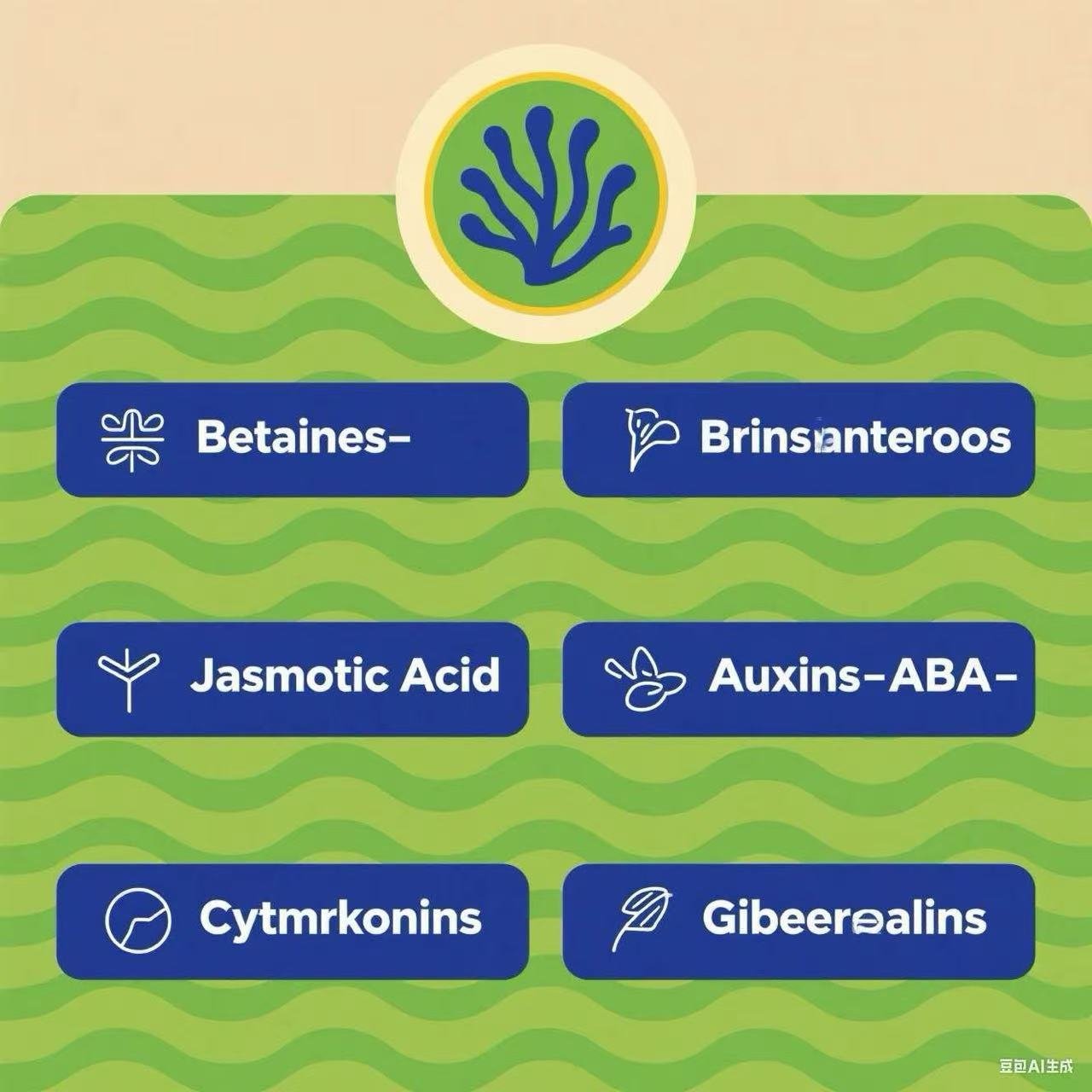
🔬 Plant Growth Regulators in Seaweed Extracts
Seaweed extracts owe their effectiveness as agricultural biostimulants to a rich mix of plant growth regulators. These include auxins, cytokinins, gibberellins, betaines, abscisic acid (ABA), jasmonic acid (JA), polyamines, and brassinosteroids—all bioactive compounds that drive crop health.
1. 🧊 Betaines
A well-documented component of seaweed extracts (Mackinnon, 2010), betaines are key for plant stress tolerance and growth:
- Stress Defense: Under salinity or water stress, betaines accumulate in the cytoplasm as organic osmolytes, pushing inorganic osmolytes into vacuoles. This maintains cellular osmotic balance and protects enzymes/metabolism from toxic high inorganic ion concentrations.
- Salt Tolerance Link: Betaine levels correlate positively with a plant’s ability to withstand salt stress.
- Protective Properties: Highly soluble and uncharged, betaines don’t harm (and often protect) enzymes and biomolecules. They shield cell membranes from heat/cold damage, preserve enzyme activity under high salt, prevent dehydration-induced protein disruption, and safeguard aerobic respiration.
2. 📈 Brassinosteroids (BRs)
Critical steroidal plant hormones that regulate key growth processes: cell elongation/division, senescence, vascular differentiation, male fertility, and photomorphogenesis.
3. 🛡️ Jasmonic Acid (JA)
An endogenous regulator in higher plants (and its methyl ester, MeJA)—derived from fatty acids:
- Triggers stomatal closure, influences N/P uptake and organic transport (e.g., glucose).
- Boosts plant defense: activates responses to mechanical damage, herbivore/insect attacks, and pathogen infections.
4. 🌱 Auxins
Endogenous hormones in brown, red, and green algae—central to seaweed extracts’ root-promoting effects. Common types include indole-3-acetic acid (IAA), indole-3-carboxylic acid (ICA), N,N-dimethyltryptamine (NNPT), indole-3-aldehyde (IAld), and N-hydroxyethylphthalimide (all detected in Ecklonia maxima-based fertilizers).
- IAA Prevalence: Found in seaweeds like Undaria pinnatifida and Porphyra; GC-MS analysis shows commercial seaweed fertilizers contain ~6.63±0.29μg/g IAA.
- Root Growth Driver: Reviews confirm auxins in seaweed extracts are a primary factor in enhancing root development.
5. 🍂 Abscisic Acid (ABA)
One of the “big five” plant hormones (alongside auxins, ethylene, gibberellins, cytokinins):
- Enhances drought and salt tolerance.
- Triggers bud dormancy, leaf abscission, and potato tuber formation; inhibits cell growth.
- Stimulates ethylene production to promote fruit ripening.
6. 🔄 Cytokinins
Powerful regulators that act via protein synthesis stimulation:
- Core roles: Promote chloroplast maturation, delay senescence, and control the cell cycle.
- Key effects: Turns treated leaves into “active amino acid sinks” (drawing nutrients from surrounding tissues); stimulates cell division (when paired with auxins in tissue culture) and morphogenesis (e.g., shoot/bud formation); boosts lateral bud growth, leaf expansion, and stomatal opening in some species.
7. 📏 Gibberellins
Versatile hormones that govern diverse growth and developmental processes: seed germination, stem elongation, leaf expansion, trichome development, root growth, and flower/fruit formation.
SeaweedScience #BioactiveFertilizers #SustainableFarming #CropHealth#SustainableAgriculture#RegenerativeFarming#PlantNutrition#SeaweedFertilizer#GreenTech#Seaweed#Seaweedextract#Biostimulant#QINGDAOSEADOM
Want to learn how to leverage these regulators for higher crop yields? Explore our full guide!