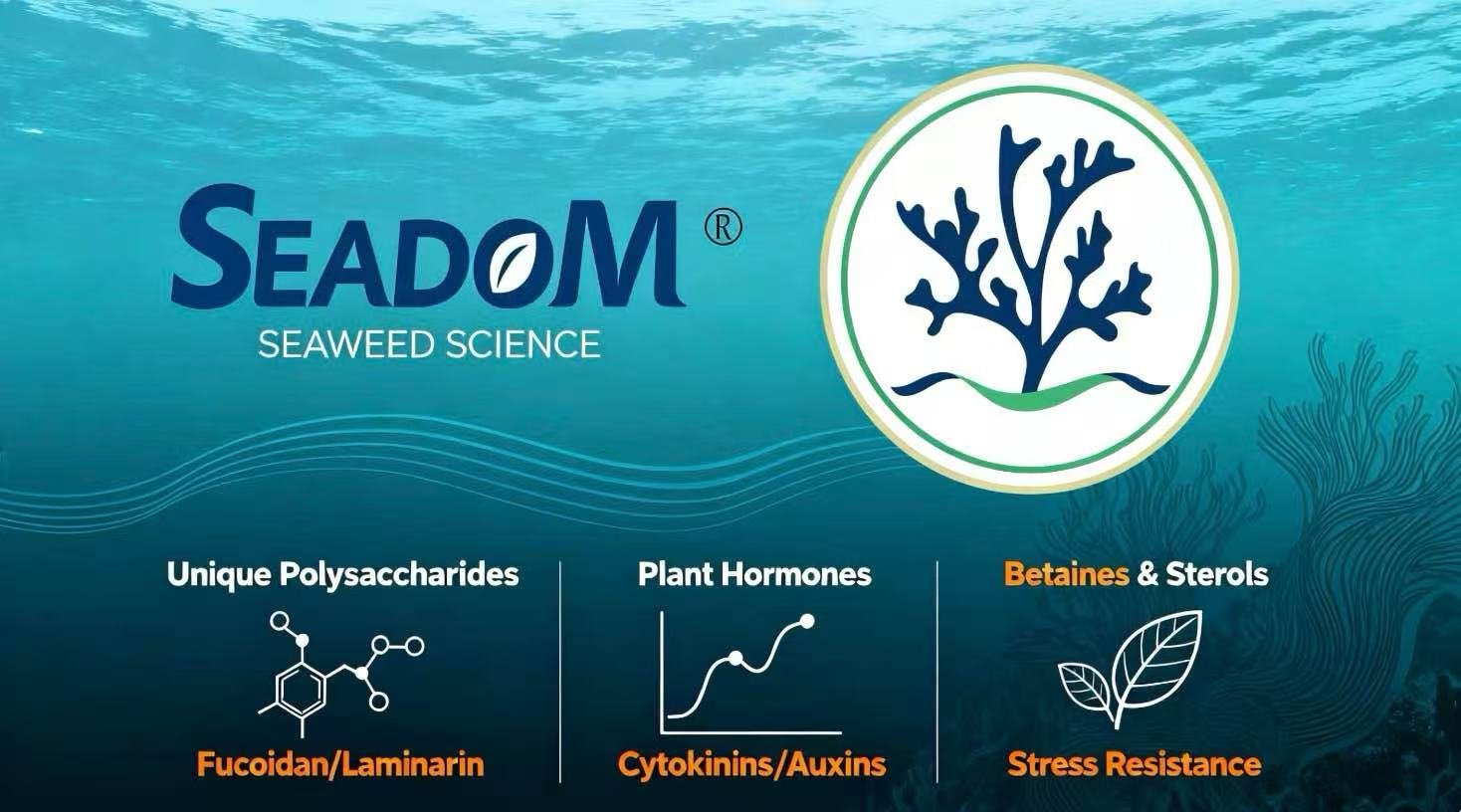
🌱 How Seaweed Bioactives Impact Plant Growth
1. 🔬 Unique Polysaccharides in Algae
Brown and red algae contain complex polysaccharides not found in land plants. For example, brown algae like Ascophyllum nodosum and Fucus are rich in alginate, fucoidan, and laminarin. Among these:
- Laminarin and fucoidan exhibit diverse bioactivities. While their direct effects on plant growth are understudied, sulfated fucoidan is well-documented for biological activity in mammalian systems.
- Laminarin stimulates plants’ natural defense responses and induces gene expression for various pathogenesis-related proteins.
2. 🌿 Plant Hormones
Liquid seaweed extracts are chemically complex, packed with diverse plant growth regulators. Importantly, their mineral content alone doesn’t drive plant growth—instead, regulatory compounds play a key role. Scientific research has identified the molecular structures of these regulators and clarified their mechanisms:
- Cytokinins: Detected in fresh algae and extracts, including trans-zeatin, trans-zeatin riboside, their dihydro derivatives, and aromatic forms like benzylaminopurine. LC-MS analysis shows 31 algae species primarily contain zeatin and isopentenyl conjugates.
- Brassinosteroids & Strigolactones: Found in seaweed extracts, these hormones influence flowering, plant architecture, stress tolerance, and immune function. Strigolactones, known to stimulate seed germination, are newly recognized as stress regulators (aiding drought/salt tolerance and nutrient responses). Exogenous application of these hormones can boost crop yields agronomically.
- Auxins: Abundant in algae—Ascophyllum nodosum extracts, for example, contain up to 50mg of indole-3-acetic acid (IAA) per gram of dry weight. Extracts from Ecklonia maxima promote mung bean root growth, consistent with auxin effects, and GC-MS confirms indole compounds. While auxins are present in red algae (e.g., Porphyra), levels are lower than in brown algae. In higher plants, IAA often binds to carboxyl groups, glycans, amino acids, or peptides, becoming active only after hydrolysis. Such conjugated forms (IAA + amino acids) have been identified in Ecklonia maxima and Macrocystis extracts, and bioactive auxin-like compounds also appear in alkaline hydrolysates of Ascophyllum nodosum, Fucus, and other algae.
3. 🔆 Betaines
Ascophyllum nodosum extracts contain various betaines and betaine-like substances. In plants:
- Betaines alleviate osmotic stress under salinity and drought.
- They slow chlorophyll degradation, boosting leaf chlorophyll content—directly linked to increased yields.
- Low concentrations act as a nitrogen source; high concentrations function as osmolytes.
4. 🧈 Sterols
Like most eukaryotic cells, algae contain sterols—key lipids with species-specific profiles:
- Land plants typically have sterols such as sitosterol, stigmasterol, 24-methylenecholesterol, and cholesterol.
- Green algae are rich in ergosterol and methylenecholesterol.
- Red algae primarily contain cholesterol and its derivatives.
- Brown algae feature fucosterol and its derivatives.
#SeaweedBioactives #PlantGrowthRegulators #OrganicFertilizer #CropScienceSeaweedScience #BioactiveFertilizers #SustainableFarming#CropHealth#SustainableAgriculture#RegenerativeFarming#PlantNutrition#SeaweedFertilizer#GreenTech#Seaweed#Seaweedextract#Biostimulant#QINGDAOSEADOM
Want to dive deeper into how these compounds enhance your crops? Explore our full guide!
https://www.linkedin.com/company/seaweedextract