Our Location
Room 1287, Yinzhushan Road,Huangdao, Qingdao, China

Room 1287, Yinzhushan Road,Huangdao, Qingdao, China

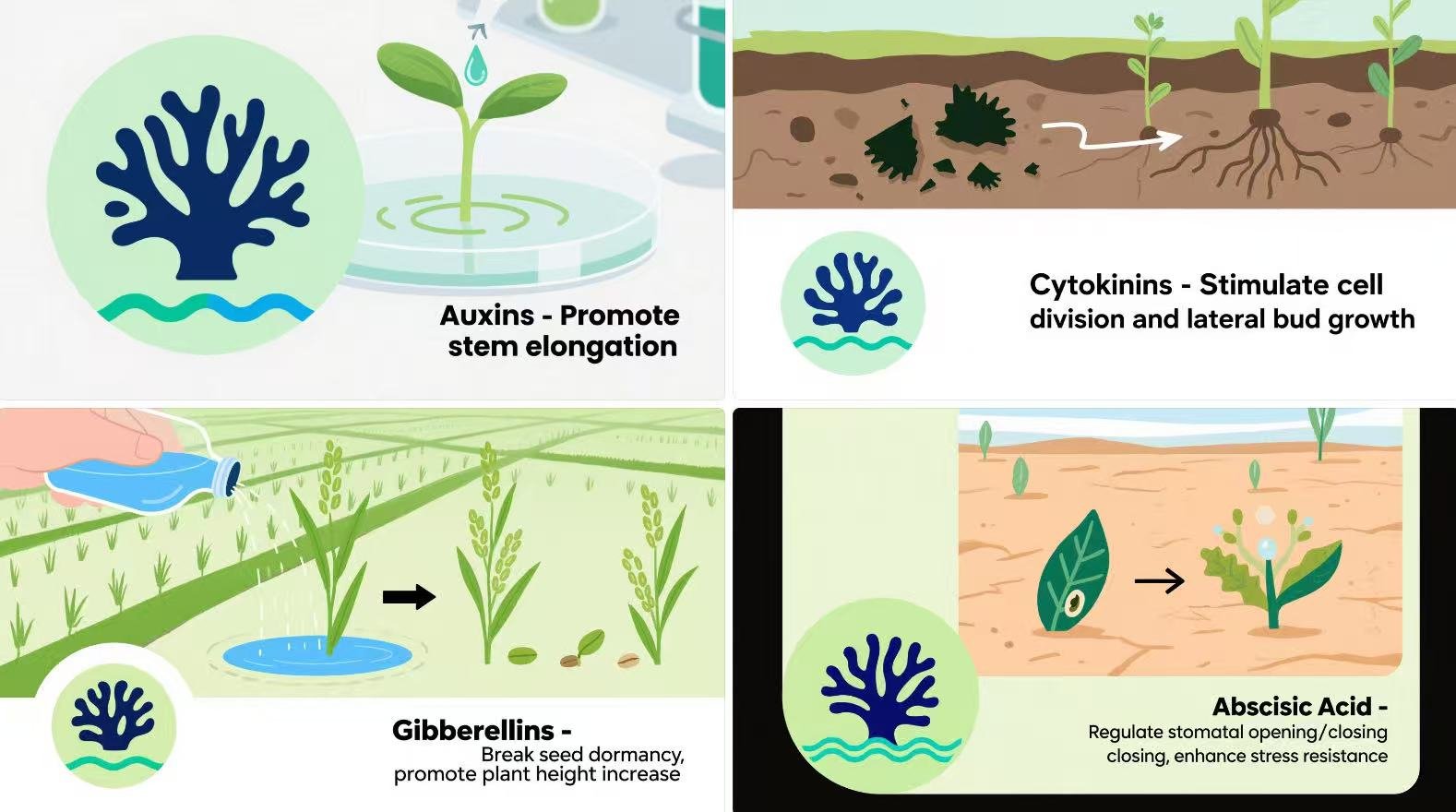
Macroalgae, the foundation of seaweed fertilizers, are not just nutrient-rich—they’re biological powerhouses. As fast-growing marine plants, they synthesize a diverse array of compounds beyond basic nutrients (N, P, K, Fe, B, Mo, I). These include structural components like polysaccharides and proteins, plus specialized bioactives: phenolic polymers (known for antioxidant properties), mannitol (a osmoprotectant), betaines (stress regulators), and a suite of plant growth hormones—cytokinins, gibberellins, auxins, and abscisic acid.
What makes seaweeds unique is their species-specific bioactive profiles, shaped by evolution in diverse marine environments. From shallow tidal zones to deep, nutrient-poor waters, each species develops distinct compounds to thrive, offering tailored benefits for crop health when harnessed in fertilizers.
Seaweeds, as simple organisms, lack the complex tissues of land plants, but their cellular structure is remarkably efficient. Their bodies consist of three key parts:
This structure ensures seaweeds can withstand harsh marine conditions (salinity, waves) while efficiently absorbing and storing nutrients—traits that translate to potent fertilizing effects.
Brown algae, including Ascophyllum nodosum, kelp, and Sargassum, are particularly valued for their cell wall components. Their polysaccharides—alginate, laminarin, and fucoidan—are more than structural; they act as signaling molecules in plants. When applied as fertilizer, these polysaccharides trigger defense pathways (via salicylic acid, jasmonic acid, or ethylene) that enhance resistance to fungi, bacteria, and pests. For instance, Ascophyllum nodosum extracts boost β-1,3-glucanase activity, an enzyme that breaks down pathogen cell walls, strengthening crop immunity.
Among brown algae, Ascophyllum nodosum is unmatched for fertilizer production, thanks to its extreme North Atlantic habitat—deep, cold waters with high pressure and low light. This environment forces the algae to evolve exceptional nutrient uptake and biosynthesis abilities, resulting in:
Comparative studies highlight its superiority:
| Seaweed Type | Indole Acetic Acid (ng/g) | Gibberellins (ng/g) | Zeatin Riboside (ng/g) |
|---|---|---|---|
| Ascophyllum nodosum | 594.22 | 66.7 | 107.94 |
| Fresh Sargassum | 15.23 | 40 | 87.94 |
| Fresh small kelp | 20.53 | 33.96 | 93.95 |
| Dried small kelp | 147.94 | 13.54 | 19.77 |
| Dried large kelp | 30.9 | 21.54 | 24.97 |
This rich blend of natural hormones and bioactives explains why Ascophyllum nodosum-based fertilizers consistently outperform others in boosting crop yield, quality, and stress resilience.
#SeaweedScience #BioactiveFertilizers #SustainableFarming #CropHealth#SustainableAgriculture#RegenerativeFarming#PlantNutrition#SeaweedFertilizer#GreenTech#Seaweed#Seaweedextract#Biostimulant#QINGDAOSEADOM