Our Location
Room 1287, Yinzhushan Road,Huangdao, Qingdao, China

Room 1287, Yinzhushan Road,Huangdao, Qingdao, China

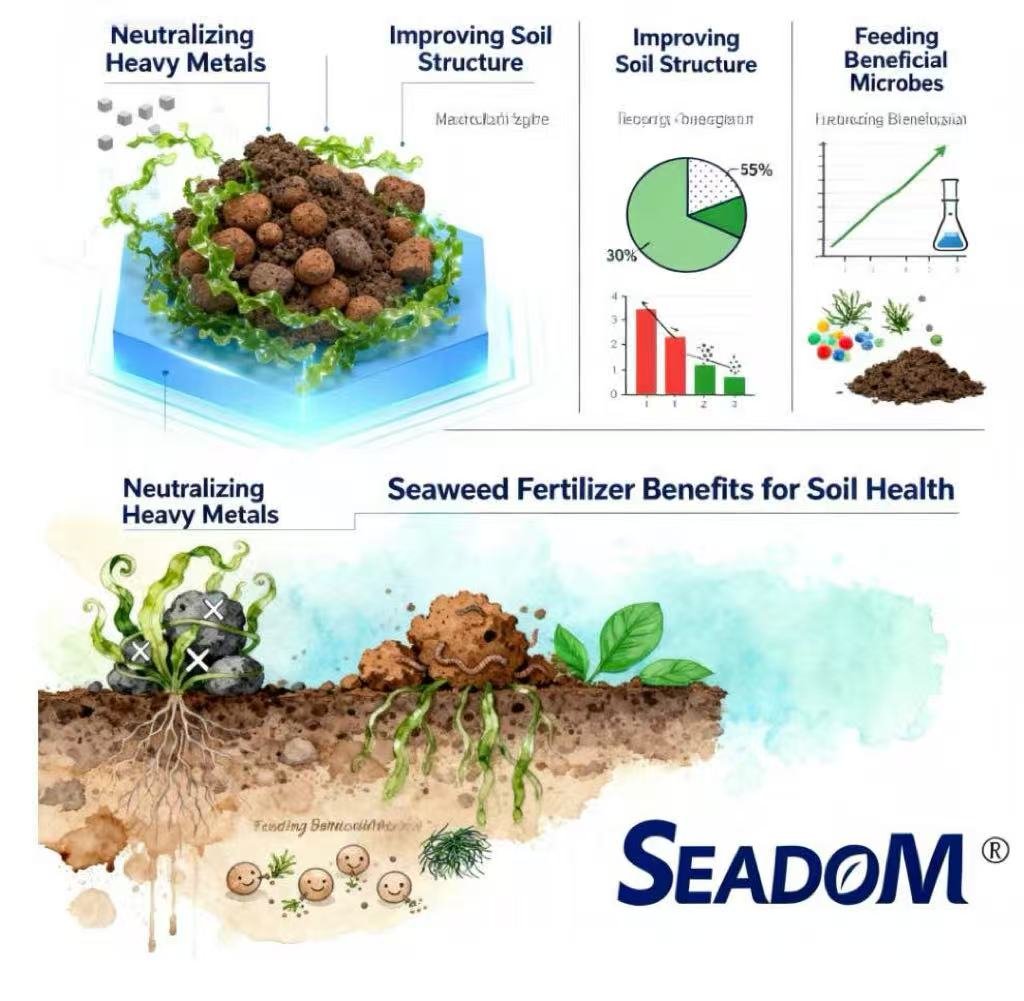
In agricultural production, seaweed fertilizer enhances crop yield and quality by improving soil conditions, promoting plant growth, and preventing pests and diseases.
Soil is a fundamental resource for human survival, the foundation of all agricultural ecosystems, and a carrier for human life. As the saying goes, “All things grow from soil, and food depends on soil.” In recent years, irrational fertilization has led to massive residues of chemical fertilizers and pesticides in soil and water. Particularly, the intentional or unintentional introduction of harmful elements (detrimental to crop health) into soil directly causes soil pollution. This not only indirectly contaminates water through soil but also damages the atmosphere via emitted gases—even polluting agricultural products (closely linked to human life) and becoming a major threat to human health.
Seaweed fertilizer is a natural soil amendment. Its application not only chelates heavy metal ions in soil to reduce pollution but also promotes the formation of soil aggregate structure and increases soil organic matter (directly or indirectly). The organic substances (e.g., vitamins) and trace elements rich in seaweed fertilizer activate various soil microorganisms, boost soil biological activity, accelerate nutrient release, and make soil nutrients available for plants.
A common feature of soil degradation is the gradual loss of aggregate structure. Recognized globally as the optimal soil structure, aggregate structure forms when soil particles clump together into aggregates. Small pores form between individual particles, and large pores between aggregates—allowing the soil to retain both water and air. It acts as a “small reservoir” and “small fertilizer bank” for soil, ensuring healthy root growth.
Alginate (from seaweed) has gelling properties: it promotes the formation of soil aggregates, stabilizes soil colloid characteristics, optimizes the soil’s water-fertilizer-air-temperature system, and enhances soil physical fertility.
By improving soil water-holding capacity and promoting the growth of beneficial soil microorganisms, seaweed fertilizer enhances soil health. The hydrophilic, gelling, and heavy-metal-chelating properties of seaweed polysaccharides (e.g., alginate, fucoidan) are crucial for improving soil performance (Cardozo, 2007; Rioux, 2007; Lewis, 1988). When alginate binds to metal ions in soil, it forms high-molecular-weight gel complexes that absorb water, swell, retain soil moisture, and improve aggregate structure. This enhances soil aeration and the capillary effect of soil micropores—stimulating plant root growth and increasing soil microbial activity (Eyras, 1998; Gandhiyappan, 2001; Moore, 2004). Additionally, the anionic properties of seaweed and single-cell algae have significant applications in remediating soil contaminated by heavy metal ions (Metting, 1988; Blunden, 1991).
Rhizosphere microbes (bacteria, actinomycetes, fungi, algae, protozoa, etc.) grow and reproduce in the soil zone directly influenced by plant roots. They act as catalysts in the metabolite cycle of the plant-soil-microbe system. Studies show that seaweed and its extracts promote the growth of beneficial soil microorganisms, stimulate their secretion of soil amendments, improve the rhizosphere environment, and thus boost crop growth.
Arbuscular mycorrhizal fungi (AMF) are a group of fungi widely distributed in forest soils. They form arbuscular mycorrhizae (AM) with over 80% of terrestrial plants. AM improves the host plant’s absorption and utilization of mineral elements (e.g., phosphorus, zinc, calcium) and water, increases plant hormone production, and promotes host plant growth.
Various seaweed extracts act as growth regulators for AMF. When applied to soil, they stimulate the growth of beneficial microorganisms, which secrete soil-regulating substances to improve soil properties and further promote the growth of beneficial fungi (Ishii, 2000). Oligosaccharides derived from enzymatic hydrolysis of alginate (from brown algae) significantly stimulate the growth and elongation of mycorrhizae and hyphae, enhance their infectivity to Citrus reticulata seedlings, and promote fungal growth (Kuwada, 2006).
Research by Kuwada et al. (1999) showed that methanol extracts of brown algae promote hyphal and root growth. Ethanol extracts of brown algae (in in vivo experiments) promote AMF hyphal growth and induce AM colonization of citrus. When liquid fertilizer containing seaweed extracts is sprayed in citrus orchards, AMF spore count increases by 21% and colonization rate by 27% (compared to the control group). Other studies indicate that root application of methanol extracts from red and green algae significantly promotes the growth and development of rhizosphere microbes in papaya and passion fruit. Similar to brown algae, red and green algae contain AMF growth regulators, which play a key role in the development of rhizosphere microbes in higher plants (Wang Jie, 2011).
In recent years, soil heavy metal pollution has become an increasingly serious environmental issue. Heavy metals contaminating soil include highly toxic elements (mercury [Hg], cadmium [Cd], lead [Pb], chromium [Cr], arsenic [As]) and moderately toxic elements (zinc [Zn], copper [Cu], nickel [Ni]). These heavy metals mainly come from pesticides, wastewater, sludge, and atmospheric deposition—for example, Hg from Hg-containing wastewater, and As from agricultural insecticides, fungicides, rodenticides, and herbicides.
Heavy metal pollution disrupts plant physiological functions and causes nutrient imbalances. Hg and As weaken or inhibit the activity of nitrifying and ammonifying bacteria in soil, affecting nitrogen supply. Heavy metal pollutants have low mobility in soil: they are not easily leached by water or degraded by microorganisms. Their potential harm is enormous when they enter the human body through the food chain—making the prevention and control of soil heavy metal pollution imperative.
Alginic acid (a high-molecular-weight carboxylic acid) can adsorb metal cations in soil to form alginates. As shown in Figure 7-2, the main adsorption sites of alginic acid are the carboxyl groups on the outer side of its molecular chain. When divalent or multivalent metal ions (e.g., Hg, Cd, Pb, Cr, Zn, Cu, Ni) in soil bind to alginic acid, they form water-insoluble, highly hydrophilic high-molecular-weight complexes. On one hand, this inactivates heavy metal ions; on the other hand, the complexes absorb water and swell—retaining soil moisture, improving soil block structure, facilitating soil pore ventilation and capillary activity, and in turn stimulating the growth and development of plant roots and enhancing soil microbial activity. Beyond alginic acid, the polyanionic properties of seaweed and single-cell algae are also valuable for soil remediation—especially for soil contaminated by heavy metals.
#SeaweedFertilizer #SoilHealth #AgriculturalScience #HeavyMetalRemediation #SustainableFarming