Pest & Disease Control
🕷️ First: Tackling Plant-Eating Mites
Plant-eating mites (e.g., spider mites, gall mites, root mites) are major troublemakers—they pierce or chew plants, with spider mites ranking among the world’s top 5 crop pests. These tiny pests suck chlorophyll, causing yellow spots, leaf drop, and damage. Worse, they reproduce fast, adapt easily, and build resistance to chemicals. Over-reliance on chemical miticides has made them even bigger threats: it kills their natural enemies, worsens pollution, and lets other pests multiply.
Here’s where seaweed fertilizer helps:
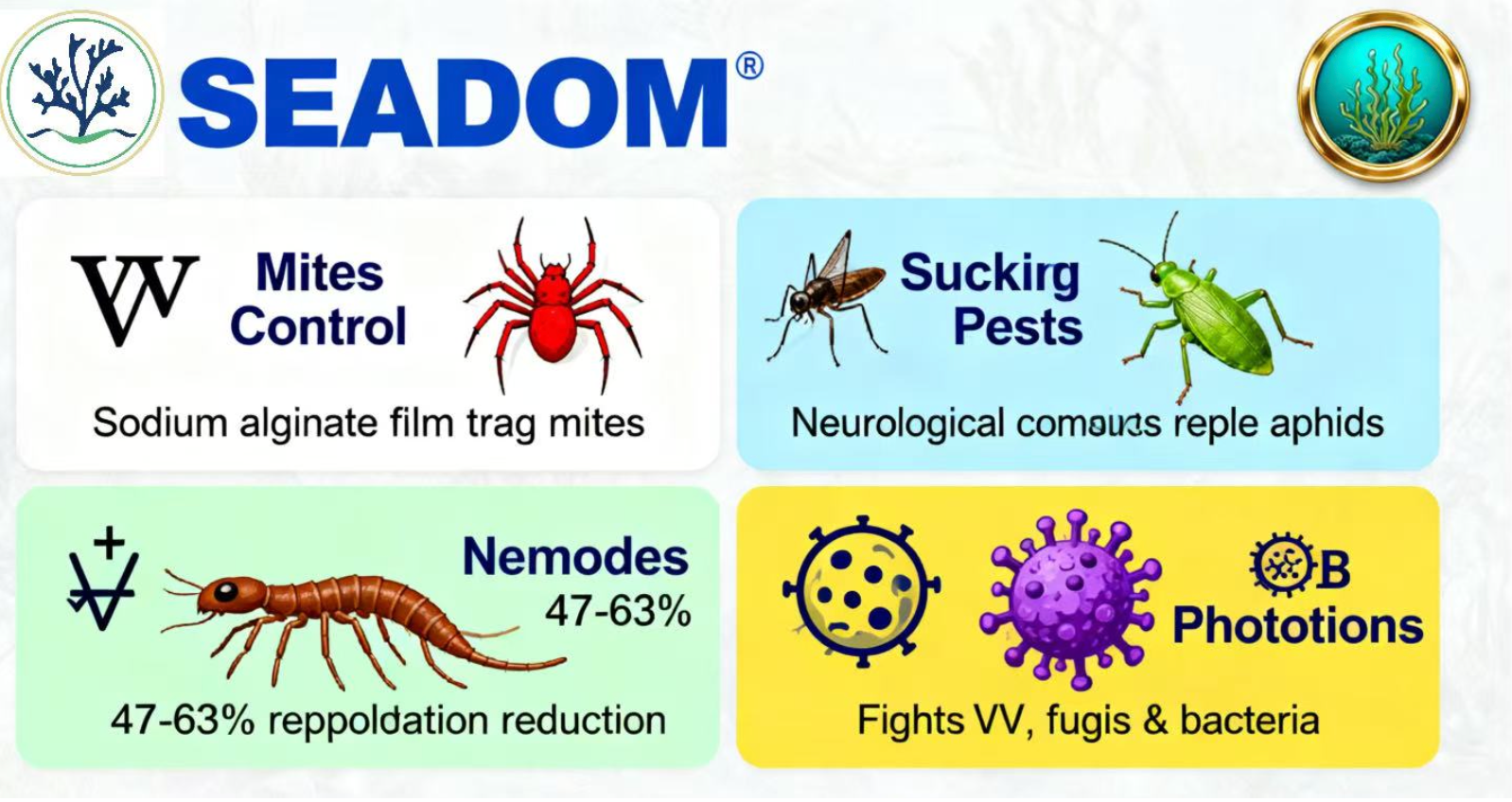
- Seaweed extract’s sodium alginate forms a soft, airtight film on plants when dry. This traps mites, suffocates them, and cuts off their energy exchange—effectively killing them.
- Studies prove seaweed’s metal chelates reduce red mite populations. Spraying it on strawberries lowers two-spotted spider mites; on apple trees, it controls red spiders. Sodium alginate even works as an ideal mite killer for tea plants.
🦟 Next: Fighting Sucking Pests
Sucking pests (e.g., aphids) are another big crop threat. Small, fast-reproducing, and easy to ignore early on, they cluster on tender branches, leaves, and fruits to suck sap. This causes curled leaves, wilting, and even plant death—plus, they spread sooty mold and viruses, ruining quality and yield. Chemical pesticides fix this temporarily but leave residues and harm ecosystems.
Seaweed extract offers a better way:
- It contains polyhalogenated monoterpenes that target sucking pests’ nervous systems. Treated plants avoid aphid and similar pest attacks.
- Spraying seaweed extract in peach orchards eliminated red spider mite larvae (while they still appeared in control areas). Both foliar and soil applications repel aphids.
- Red algae extracts strongly kill tobacco hornworm and mosquito larvae—even outperforming nereistoxin-based insecticides. It also protects greenhouse crops (sugarcane, bananas, strawberries, etc.) from pests.
🪱 Then: Controlling Root-Knot Nematodes
Root-knot nematodes are the most widespread, damaging plant-parasitic nematodes—harming over 80 crops (vegetables, peanuts, soybeans, citrus) worldwide. They cause huge losses: peanut yields drop 30-40% (up to 80% in severe cases), while soybean yields fall 70-80% with severe infestations. Chemicals work but clash with eco-friendly goals—so safer solutions are a must.
How seaweed fertilizer stops them:
- It changes the ratio of plant endogenous auxins to cytokinins, building nematode resistance (Featonby-Smith, 1983).
- Treating corn roots with seaweed extract cut nematode reproduction by 47-63% (De Waele, 1988).
- It boosts plants’ natural pest defenses (Allen, 2001) and improves rhizosphere microbes, lowering nematode infections (Wu, 1997; Crouch, 1993).
🦠 Finally: Defending Against Pathogens (Bacteria, Fungi, Viruses)
Seaweed’s active compounds 激发 plants’ ability to fight bacteria, fungi, and viruses—cutting pesticide use. Here’s the proof:
🔬 Against Viruses
- Seaweed fertilizer boosts tobacco’s resistance to tobacco mosaic virus (TMV).
- Alginate increases tobacco leaves’ antioxidant activity (via POD/SOD enzymes) and triggers PR-1a/N gene expression to fight viruses. It inactivates 66.67% of TMV and inhibits 34.67% of its replication (Chen Qianyi, 2016).
- Seaweed extract inactivates tomato cucumber mosaic virus (CMV) in vitro, reducing virus levels in infected plants and protecting chloroplasts (Guo Xiaodong, 2006).
🍄 Against Fungi
- Seaweed extract stops Pythium ultimum growth on cabbages and reduces Phytophthora capsici infections on peppers.
- It lowers gray mold in tomatoes, blast in rice, and soft rot/downy mildew in autumn Chinese cabbage.
- Alginate protects apple branches from canker. Extracts from red algae inhibit cowpea rust, Chinese cabbage black spot, potato late blight, and mango anthracnose.
🦠 Against Bacteria
- Seaweed ethanol extracts fight Ralstonia solanacearum (the bacteria causing sweet potato bacterial wilt).
- Spraying cotton seedlings with seaweed extract boosts their resistance to bacterial attacks. Soaking cotton seeds in 1:500 sargassum extract for 12 hours makes seedlings highly resistant to Xanthomonas campestris.
🧪 The Science Behind It
Seaweed works by:
- Inducing Systemic Acquired Resistance (SAR): Its polysaccharides (e.g., sulfated polysaccharides from brown algae) act as “signals” to trigger plants’ defense responses.
- Feeding Beneficial Microbes: It stimulates microbes that fight fungal pathogens (e.g., on cabbages, Dixon, 2002).
- Boosting Antioxidants & Genes: It increases SOD activity (reducing dollar spot in bentgrass) and triggers defense genes (e.g., PR-10 for virus resistance, van Loon, 2006; 152 defense-related genes in alfalfa, Cluzet, 2004).
- Using Natural Antimicrobials: It’s rich in polyphenols that fight pathogens directly.
#SeaweedScience #BioactiveFertilizers #SustainableFarming #CropHealth#SustainableAgriculture#RegenerativeFarming#PlantNutrition#SeaweedFertilizer#GreenTech#Seaweed#Seaweedextract#Biostimulant#QINGDAOSEADOM
https://www.linkedin.com/company/seaweedextract