Our Location
Room 1287, Yinzhushan Road,Huangdao, Qingdao, China

Room 1287, Yinzhushan Road,Huangdao, Qingdao, China

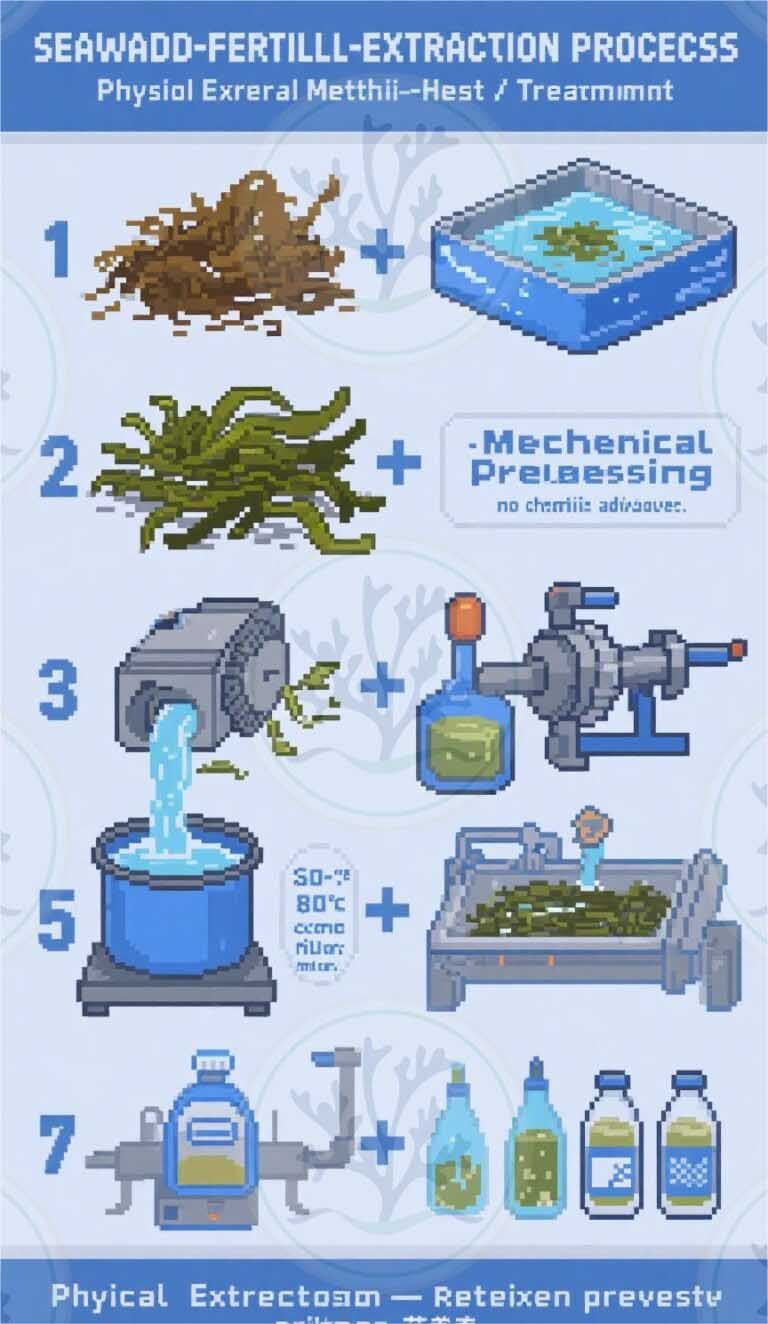
Half a century of development has produced a wide range of seaweed processing technologies. Each one isolates active compounds in a different way, and each leaves a different fingerprint on the final product.
Five seaweed processing technologies dominate fertilizer production today. Each one trades speed, cost and bioactivity in a different way:
Water extraction is the simplest of the five seaweed processing technologies. It relies on temperature and time rather than chemicals, and it runs in four steps.
This route uses acids such as formic, acetic or sulfuric acid, and alkalis such as NaOH, KOH or carbonates. It breaks down polymers that water alone cannot touch.
Sulfuric acid at 40–50°C for 30 minutes removes phenolic compounds. It also enhances polymer degradation, which improves the efficiency of the following alkali step and the quality of the final product.
Seaweed treated with 0.1–0.2 mol/L sulfuric acid or HCl becomes more fluid than untreated material. It also takes on a green hue, which helps separation through drum screening.
Ground seaweed slurry is heated in water. K₂CO₃ is added in pressure reactors at 275–827 kPa and below 100°C. Under these conditions, polysaccharide chains break into low-molecular-weight substances.
After extraction, the solution is neutralised with H₃PO₄ or citric acid (C₆H₈O₇).
Alkali treatment triggers degradation, recombination and condensation reactions. The outcome is a set of compounds that do not exist naturally in seaweed:
Wild seaweed is collected from the coast and moved straight into cold storage for rapid freezing. Liquid nitrogen then pulverises it into a suspension with a 10 μm particle size.
This green-brown micro-pulverised suspension is acidified to preserve bioactivity, giving a final product with a pH below 5. The extract is viscous, stable at room temperature and easy to dilute.
Its key components include chlorophyll, alginate, laminarin, mannitol and fucoidan, with total solids of 15–20%. Growth regulators (auxins, cytokinins, gibberellins, betaines), amino acids, minerals (S, Mg, B, Ca, Co, Fe), antioxidants and vitamins complete the profile.
Unlike chemically processed fertilizers, this method uses no organic solvents, acids or alkalis. The active substances therefore stay intact.
This seaweed processing technology uses neither heat nor chemicals. Seaweed biomass is rinsed with fresh water, frozen at -25°C, then crushed into fine particles.
After homogenisation into a 6–10 μm emulsion, the mixture is injected into a low-pressure chamber under high pressure. The rapid pressure drop ruptures cell walls through internal energy release, which frees the cytoplasmic contents.
Filtration then recovers water-soluble fractions rich in natural actives. Additives can be blended later for tailored applications. South Africa’s Kelpak used this frozen cell disruption method in 1983 to produce seaweed fertilizers from local Ecklonia maxima.
Enzymatic hydrolysis is the newest of the five seaweed processing technologies. It is a biodegrading process that uses specific enzymes. It retains more active ingredients than older routes, which raises fertilizer efficacy. In recent years it has largely replaced traditional chemical and physical extraction.
In practice, the choice among seaweed processing technologies comes down to two questions. Which active compounds does the crop need, and what will the buyer pay for them?
Water extraction and low-temperature processing protect heat-sensitive compounds. Alkali routes unlock polysaccharides but generate new byproducts. High-pressure disruption keeps the profile clean without solvents. Enzymatic hydrolysis targets specific bonds and leaves the rest intact.