Our Location
Room 1287, Yinzhushan Road,Huangdao, Qingdao, China
Room 1287, Yinzhushan Road,Huangdao, Qingdao, China

Two southern-hemisphere kelps appear repeatedly in seaweed fertiliser literature: Ecklonia maxima, the sea bamboo of the Benguela current, and Durvillaea potatorum, one of the bull kelps of the Southern Ocean. Both are large brown algae, both are commercially harvested, and both are frequently cited by suppliers whose products are not made from them. Knowing their biology makes it easier to read those claims.
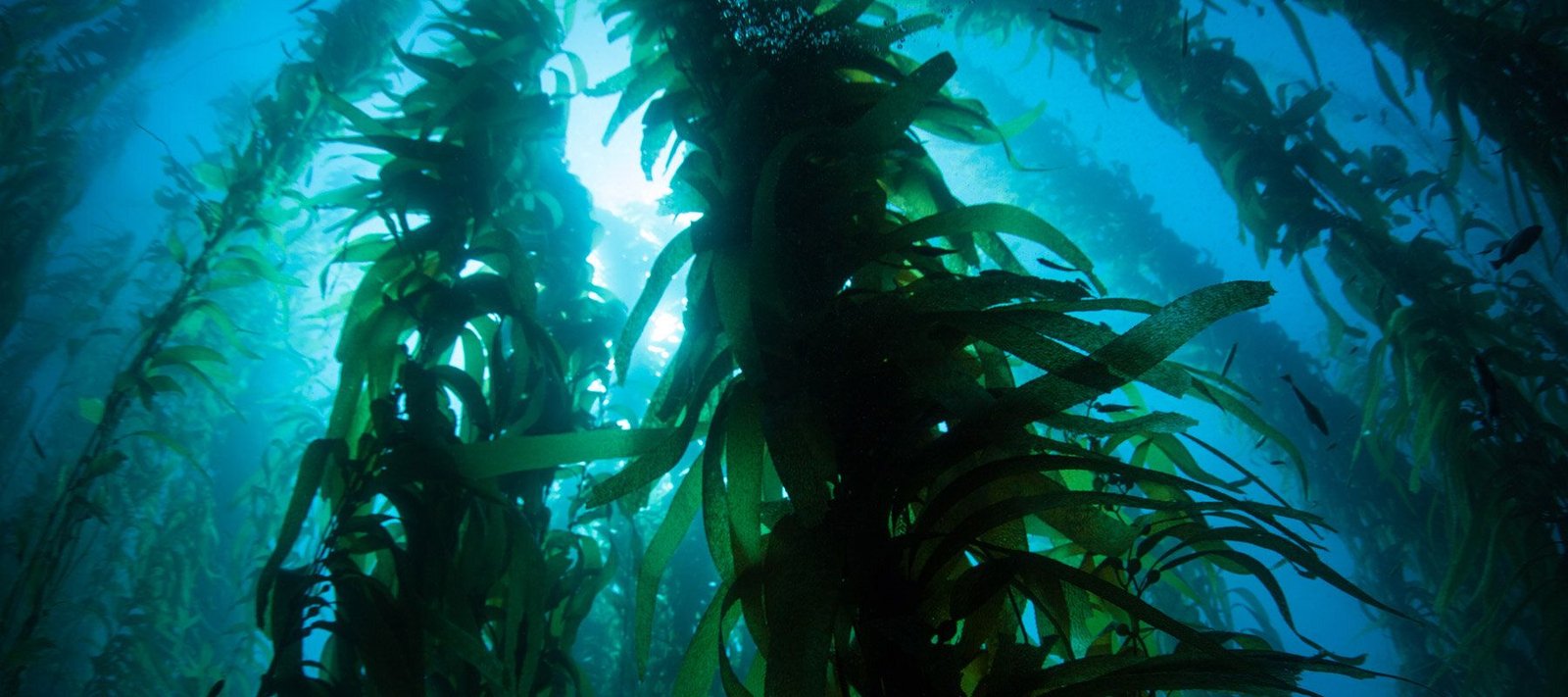
A brown alga in the order Laminariales, found on the Atlantic coast of southern Africa from the Cape Peninsula north into Namibia. The thallus is clearly divided into a thick, trunk-like stipe and a cluster of blades at the top — the resemblance to a small tree is what gives it the name sea bamboo. Vesicles at the base of the blades keep the photosynthetic tissue suspended near the surface, and a holdfast anchors the plant to reef and rock in water up to about eight metres deep.
Ecklonia maxima dominates the shallow temperate reef along South Africa’s west coast, where the cold, nutrient-rich Benguela upwelling keeps water temperatures low year round. It forms dense underwater forests that support a substantial part of the local inshore ecosystem. The species is dual purpose: it is processed into agricultural inputs, and it is the principal feed in South African abalone aquaculture, which is one reason harvest volumes are watched closely.
South African kelp harvest is permit-regulated rather than open access. Commercial supply comes from licensed cutting of standing beds and from beach-cast collection after storm events. For a buyer, the practical point is provenance: a genuine Ecklonia maxima product should be able to name the harvest region and the permit basis, because the resource is managed and the volumes are finite.
A brown alga of the order Fucales, family Durvillaeaceae. The genus contains a small number of described species, distributed through the Southern Hemisphere — New Zealand, southern Australia, Chile and the subantarctic islands. The common name bull kelp refers to the build: a massive holdfast, a short and very thick stipe, and a long leathery blade that withstands heavy surf on exposed coasts. Durvillaea potatorum is the species most associated with Tasmania, where beach-cast biomass has been collected for alginate extraction for generations.
| Species | Origin | Notable composition | Typical use |
|---|---|---|---|
| Ecklonia maxima | South Africa, Namibia — cold Benguela water | high mannitol and hormone fraction, moderate alginate | biostimulant extracts, abalone feed |
| Durvillaea potatorum | Tasmania, southern Australia, New Zealand | very high alginate, thick cell wall | alginate extraction, fertiliser raw material |
| Ascophyllum nodosum | North Atlantic — Canada, Norway, Ireland, Scotland | high betaine and mannitol, alginate around a quarter of dry weight | the reference species for biostimulant manufacture |
Our own extract line is built on Ascophyllum nodosum from the Canadian North Atlantic, not on either of the kelps above. The reasoning is supply and process rather than marketing: the North Atlantic resource is harvested under long-established quota systems with monitored regrowth, the cold-water composition gives a high betaine and mannitol fraction that survives enzymatic hydrolysis well, and the biomass density supports consistent year-round production. The Ascophyllum profile covers the species in detail.
Ecklonia maxima and Durvillaea potatorum are included here because buyers meet them constantly in competitor literature and reasonably ask how they compare. Compositionally they are all brown algae with the same broad families of actives — alginate, fucoidan, mannitol, betaines. What differs is the ratio, the harvest model and the cost of getting the biomass to a factory.
Related reading: Ascophyllum Nodosum: The Sustainable Secret | Sargassum: The Rising Star | Enteromorpha (Green Algae) | Seaweed Fertilizer Active Ingredients