Our Location
Room 1287, Yinzhushan Road,Huangdao, Qingdao, China

Room 1287, Yinzhushan Road,Huangdao, Qingdao, China

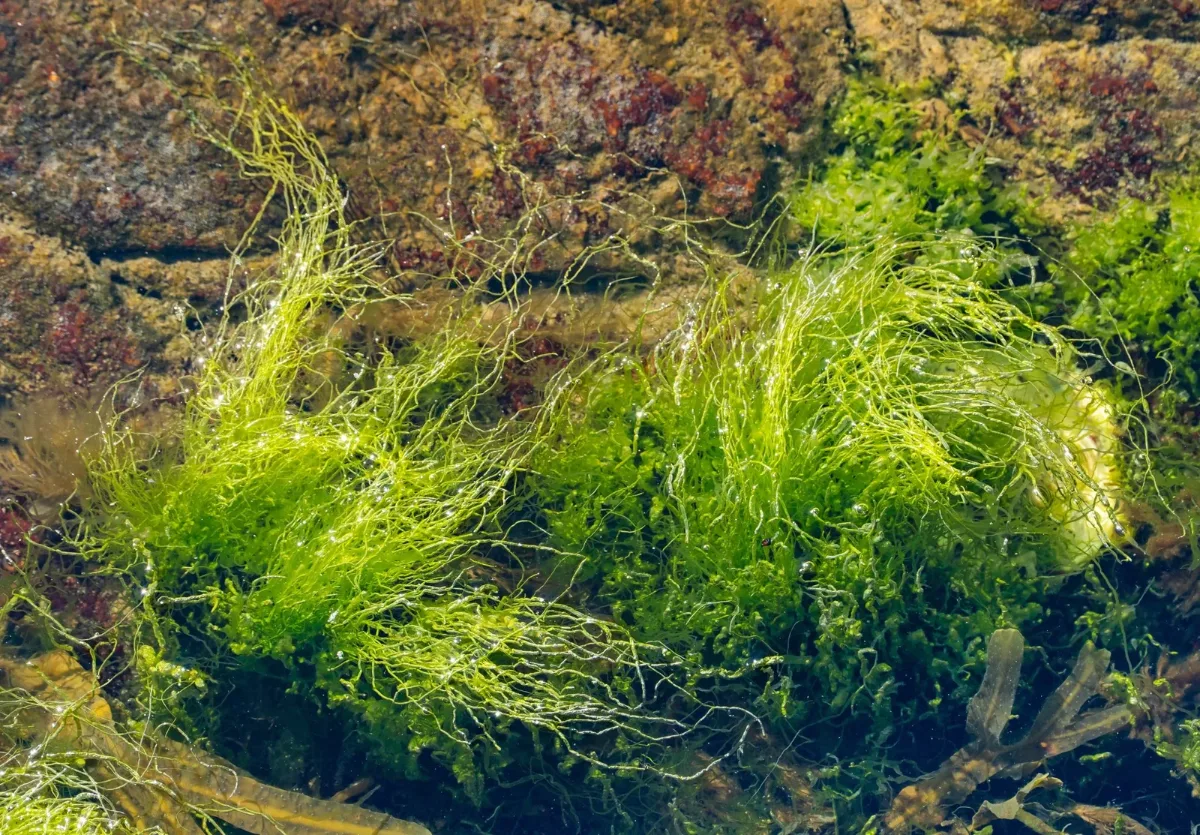
Enteromorpha is the green alga most people meet without realising it: the bright grass-green sheets on harbour walls and tidal flats in summer, and the drifting biomass that closes beaches in the Yellow Sea. In the fertiliser trade the name is used for a cheap, abundant raw material; in taxonomy it is a name that has largely been retired. Both facts matter to anyone specifying it.
Enteromorpha sits in the phylum Chlorophyta, order Ulvales, family Ulvaceae. Its thallus is tubular and hollow, one cell thick, branching from the base — that hollow tube is the defining feature, and it is why the genus was separated from the flat, sheet-like Ulva for well over a century. Molecular work published in the early 2000s showed the two genera do not separate cleanly on DNA, and most former Enteromorpha species are now accepted as Ulva. Trade literature, and a good deal of Chinese-language sourcing documentation, still uses Enteromorpha, so both names remain useful in practice even though only one is currently accepted.
Enteromorpha is a classic opportunist. It colonises intertidal and shallow subtidal hard surfaces — rock, gravel, sand, tidal flats, estuary walls — tolerates a wide salinity range, and takes up nitrogen and phosphorus directly across a very thin cell wall. The tubular thallus gives it an unusually high surface-to-volume ratio, which means nutrient uptake and growth rates far above those of slower, thicker macroalgae. Give it nutrient-rich water and warm temperatures and it converts that advantage into biomass within weeks.
That growth capacity is also the problem. In the Yellow Sea, massive floating mats of Ulva (historically recorded as Enteromorpha) have recurred every summer since 2007, drifting north with the currents and coming ashore along the Shandong coast, Qingdao included. The 2008 sailing events made the phenomenon internationally visible when cleanup crews removed tens of thousands of tonnes from the water in the weeks before the regatta.
The ecological mechanism is straightforward. Dense mats shade out benthic algae and seagrass; the biomass clogs fish gills; and when it decays, bacterial decomposition strips oxygen from the water column and produces hydrogen sulphide, creating localised dead zones. The cause is still debated in detail, but the contributing factors are consistent across the literature: agricultural and municipal nutrient discharge into coastal water, expanding aquaculture structures that give the alga something to attach to, and warmer winter water temperatures.
What makes Enteromorpha interesting as an input is not its hormone content — it has essentially no alginate or fucoidan, unlike the brown algae — but its protein and fibre load. Published analyses of Enteromorpha clathrata, Ulva lactuca and Caulerpa racemosa put more than 92% of the dry matter into three fractions: polysaccharide, protein and crude fibre.
| Fraction | Reported range | Why it matters |
|---|---|---|
| Dietary fibre | 64.22–70.80% | bulking and water-holding in soil mixes; fibre carrier in feed |
| Crude protein | 14.15–18.91% (average 16.16%) | the highest protein level among the common seaweed raw materials |
| Minerals | Fe, Zn, I present | supplemental trace elements, but variable with site and season |
| Vitamin C | present | antioxidant fraction; largely lost in high-temperature drying |
| Ash and salt | high | the practical constraint for fertiliser use — raises EC and sodium load |
Enteromorpha is not used fresh. The biomass is collected, desanded, dewatered, dried and milled, and each of those steps removes value if done badly. Sand and shell fragments are the main contaminant, because the alga grows on and around sediment; salt is the second, because it grows in seawater. A specification that states ash content and sodium level is worth more than one that states only protein.
Once milled, the material goes into three applications: seaweed feed additive, soil conditioner, and as a partial raw material in organic fertiliser blends, where its fibre and protein contribute to the organic matter fraction.
Enteromorpha and the brown-algae extracts sold as biostimulants are not interchangeable, and the difference is compositional rather than a matter of quality. Green algae give protein, fibre and minerals cheaply. Brown algae give alginate, fucoidan, mannitol and betaines — the fractions that drive stress tolerance and root response. A formulation that needs a biostimulant effect uses Ascophyllum nodosum; a formulation that needs an economical organic carrier with a credible protein figure can use Enteromorpha. The two are complementary in a blend, not substitutes.
Related reading: Sargassum: The Rising Star for Seaweed Fertilizers | Seaweed Processing Technologies | Overview of Seaweed Fertilizers | Seaweed Fertilizer Active Ingredients